Four Cranes – for string quartet (2026)
premiered on May 23, 2026 by the Zilliacus Quartet during the Ljudvågor Festival in Vårdklockans Kyrka, Visby, Sweden
violin I – Cecilia Zilliacus
violin II – Tale Olsson
viola – Ylvali McTigert-Zilliacus
violoncello – Kati Raitinen
“Four Cranes” took its main source of inspiration from a notebook cover, without a doubt the most peculiar of places. This particular cover, on the front and back of a notebook given to me as a birthday
gift, contains an illustration from a Japanese wedding outer kimono fabric, which depicts a group of four red-crowned cranes flying in different directions against a bright red background decorated with flowers and leaves. I immediately fell in love with the cover’s elegance and beauty, and especially so with the detail of the cranes in flight in the foreground, their wings fully spread against the red atmosphere, clearly appearing to fly someplace, but where? It was this element of the illustration (and the mystery hidden within it) that I made manifest in the resulting composition, where the strings/ cranes slowly fly down towards the ground (experiencing several interruptions in their flight paths along the way), pause to rest for a while, then gradually lift off again into the stratosphere, continuing their journey towards the unknown.
Ruined Church – for alto saxophone, trombone, and electronics (2026)
premiered on May 22, 2026 during the Ljudvågor Festival in Vårdklockans Kyrka, Visby, Sweden
alto saxophone – Jörgen Pettersson
trombone – Ivo Nilsson
The city of Visby, on the Swedish island of Gotland, has an abundance of sites that attest to its history as a significant medieval
trading city, not least of which are the various church ruins scattered around it. These churches were abandoned following the
Reformation in the 1500s, after which they were left to decay, but were eventually put into protection by the Swedish state fromthe 1800s onwards in order to preserve them. I explored many of these ruins shortly after beginning my studies at the Gotland School of Composition, and after a while, I became fascinated by how well-preserved they were, while at the same time in shockat how these churches were now mere vestiges of what they once were centuries ago. I thereby aimed to capture this feeling in the resulting musical scenario, in which the saxophone and trombone play in a more “ruined” state, utilizing various playing techniques that produce more unusual sounds, while the electronics, mainly consisting of manipulated outdoor field recordings I made around Visby, give a stronger sense of atmosphere, almost as if standing in a ruined landscape.
Bardo (in memory of Éliane Radigue) – for analogue synthesizer and 64-channel fixed media in ambisonics (2026)
premiered on May 16, 2026 during the Ljudvågor Festival in the Sävesalen of the Gotlands Museum, Visby, Sweden
sound projection – Marcus Wrangö, Magnus Bunnskog
Created in response to the recent death of Éliane Radigue, a pioneer in electroacoustic and drone music and an extremely important influence on my work, this piece, for Behringer Neutron synthesizer and fixed media, is a meditation on Radigue’s fascination with Tibetan Buddhism, the influence of which can be seen and heard in several of her mature works, most notable “Songs of Milarepa” and “Trilogie de la Mort” (Trilogy of Death). The way the piece unfolds is loosely based on the concept of “bardo”, which, in Tibetan tradition, refers to an intermediate state (a liminal space, so to speak), most often between death and rebirth. Six such bardos exist in Tibetan Buddhism, of which two are specifically referred to in this piece; the bardo of dying, and the bardo of becoming (rebirth).
Many thanks to Audiorama, Marcus Wrangö, Magnus Bunnskog, and Mattias Petersson for helping bring this piece to life
How has winter come so soon? – 64-channel fixed media in ambisonics (2026)
premiered on January 24, 2026 during the FRST Electroacoustic Festival in the Sävesalen of the Gotlands Museum, Visby, Sweden
sound projection – Marcus Wrangö, Magnus Bunnskog
One day in mid-November, on a morning walk on Reimersholme island in Stockholm, I discovered, to my surprise, the presence of frozen puddles of water, and fallen leaves that were all covered in frost. Out of curiosity, I decided to step on the frozen puddles and rub the leaves with my fingers to see how they sounded. I was immediately struck by the inherent delicateness of the resulting noises, prompting me to capture them as field recordings. The resulting piece is a documentation of the magical inner soundworld of these natural phenomena, acting as a premonition that a real winter was soon to come.
Catharsis – for bowed electric guitar and live electronics (2025)
premiered on June 17, 2025 in the museum of the Royal College of Music, London
solo electric guitar – Tom Bradbury
After listening to the Icelandic rock band Sigur Rós for the first time in 2024, I was left with a feeling of sheer bewilderment, as I had never heard music like theirs in my life beforehand, which I am still a fan of to this day. Much of the band’s music gives the listener a feeling of walking in a dream, contributed in large part by the main singer and guitarist, Jónsi, using a cello bow on his guitar, alongside heavy use of reverb pedals. The inspiration for me to write my own piece for bowed electric guitar came several months later, mainly inspired by the intense release of emotions I often experienced whenever I listened to Sigur Rós’ music, hence the title “Catharsis”, meaning “the process of releasing, and thereby providing relief from, strong or repressed emotions”.
…my dreams wander in a withered field… – for solo piano (2023/2025)
premiered on May 26, 2025 in the Amaryllis Fleming Concert Hall of the Royal College of Music, London
solo piano – Siyu Chen
With this series of short miniatures, I took Japanese haiku poetry as my main source of inspiration; however, I did not set out to structure each miniature strictly according to haiku form (5-7-5 syllables), but rather wrote them as a reflection on how haiku poems manage to say so much by using so little. To this end, I only use four different types of musical textures throughout the piece as source material, mainly as a way to limit myself with what I can use, and also to let each miniature speak for itself without having to use a huge musical vocabulary.
The title is derived from the 2nd and 3rd lines of one of the last haiku of Matsuo Bashō, who is considered to be one of the pioneers of the haiku poem. These two lines seemed to communicate a sense of aimlessness to me, but at the same time a sort of yearning to keep traveling forward. I wanted the piece, as a whole, to communicate this idea, with the music seemingly having no clear direction but still possessing a determination to keep pressing on.
My garden is full of shards – for soprano and electronics (2025)
premiered on May 1, 2025 in the Performance Hall of the Royal College of Music, London, on the second day of the Contemporary Music in Action showcase led by Haris Kittos
texts by Edith Södergran, the composer, and Astrid Montén
soprano soloist – Astrid Montén
My interest in Swedish culture, especially the Swedish language, goes back to well before writing this piece. It mainly stems from the fact that I got the chance to meet many people from Sweden while studying at the Royal College of Music in London, which gradually led to a desire to teach myself the Swedish language. I quickly realized that I was able to pick up the language fairly quickly, being able to understand significantly large amounts of it,and this motivated me to go further and further. Fast forward to October 2024, and I got the opportunity to write a piece for a soprano student from Sweden named Astrid Montén. I’d already had sketches of ideas for setting Swedish text to music from several months before, none of which satisfied me, but once I got the opportunity to work with Astrid, I began to have a more concrete idea of what I wanted to do.
The piece is mainly centered around a Swedish poem from 1915 by Finnish poet Edith Södergran (1892-1923) called Stjärnorna (The Stars), a poem that immediately caught my attention due to its surrealistic imagery, which gave me the impression that the narrator was experiencing some sort of vision. However, given the poem’s short length, and the fact that the final piece would have to last around 4 and a half minutes long, I later asked myself: what possible way is there to extend the poem for a piece of this length? A big eureka moment came soon after: I realized that I became quite proficient in Swedish by that point, so I challenged myself to write my own text in Swedish to keep the piece all in one language. This text acts as a commentary of sorts to the Södergran text, and helps to give the impression of the singer experiencing a vision or going into an extreme state of trance. The piece later revealed itself to be more than just a setting of Stjärnorna, but something like a theater piece that had its own inherent drama to it, with the electronics helping to add to the imagery of the text.
A temple appears between the branches… and then is gone – fixed media outdoor sound installation (2025)
presented as part of the Sounds of Blossom Festival at Kew Gardens, London, from March 15 to April 6, 2025
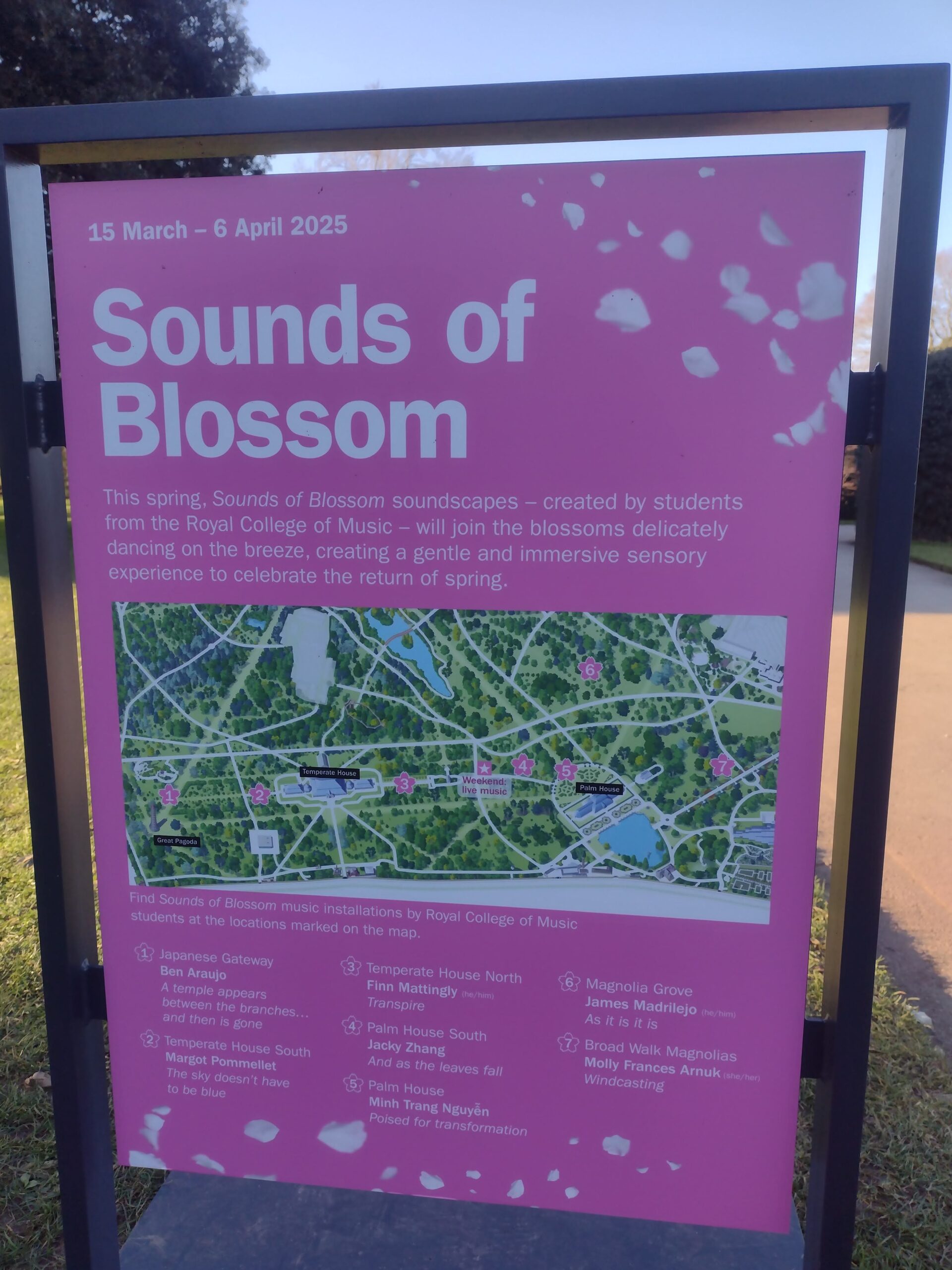
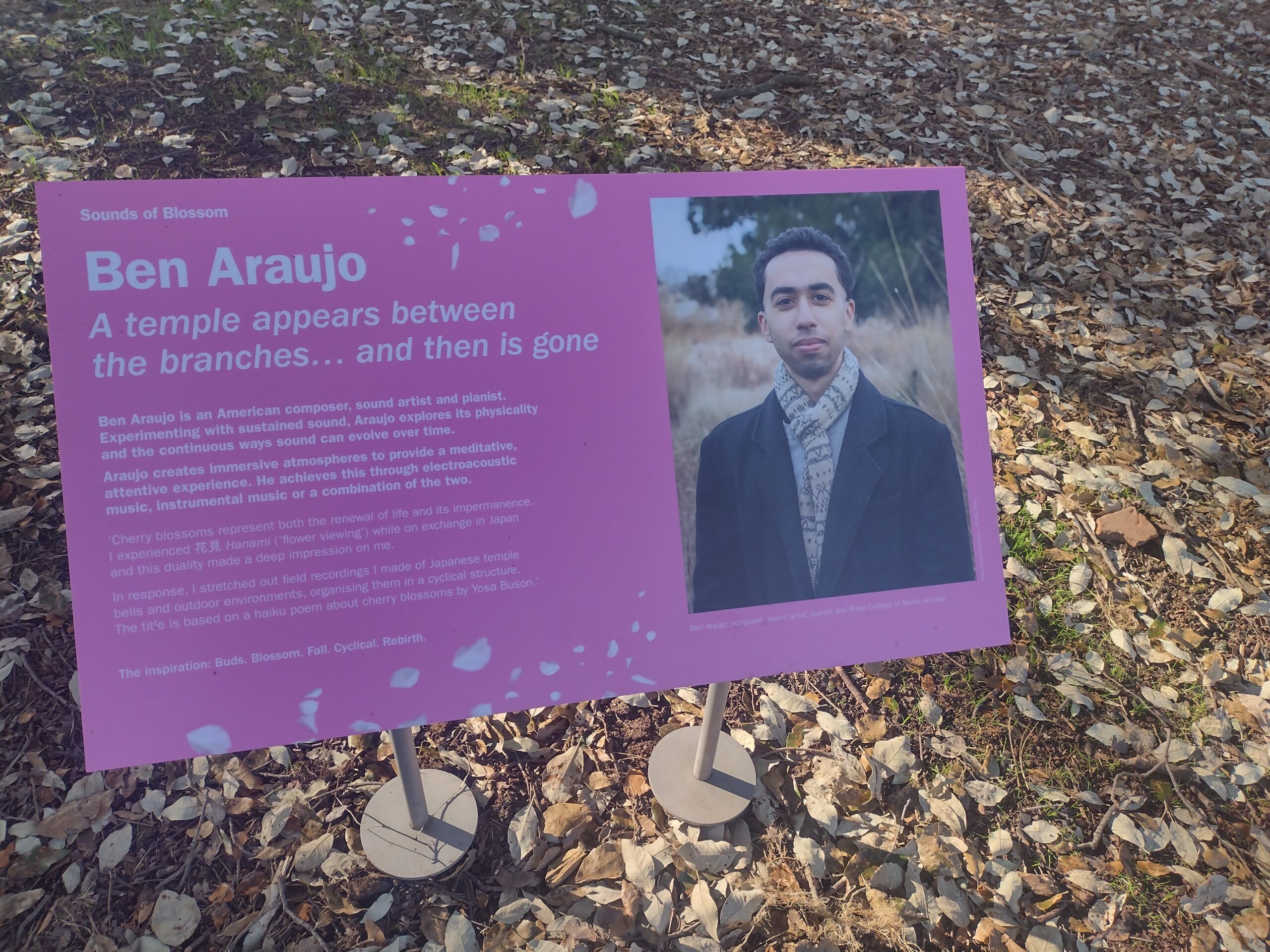
Cherry blossoms play a very significant role in Japanese culture, since they represent both the renewal of life in the spring, as well as the impermanence of life, as these flowers only come into bloom for a few weeks before withering away and falling to the ground. I was lucky enough to witness cherry blossoms in bloom with my own eyes during an exchange period in Japan; being surrounded by the blossoms’ colorfulness and vibrancy was an experience in itself, but what made it more poignant was to see the cherry blossoms gradually disappear from the tree branches. Thinking back on it now, since this experience felt so visceral for me, I therefore wanted to base my installation on the cyclical nature of life that cherry blossoms represent.
The title of the installation is based on a haiku poem about cherry blossoms I discovered by Yosa Buson, which I adapted to better represent the themes of impermanence and renewal. For the installation, I exclusively used field recordings that I took while I was in Japan, mainly of outdoor environments and temple bells, all of which I stretched out to make them more atmospheric. I then structured it in such a way so that the outdoor environments come first, then the temple bells, then the outdoor environments again, so as to depict a life cycle of sorts, in this case through sound.
grey – for orchestra (2025)
performed on March 12, 2025 for the Royal College of Music’s Composers Orchestral Workshop
When I set out east from Kyoto one morning in July to visit the city of Ōtsu, located on the coast of Japan’s largest lake, Lake Biwa, I was met with an unexpected sight. The sky was completely overcast with grey clouds, which gave the view over the lake a sense of mystery as I hadn’t experienced before. I later experienced a similar feeling later that day when I visited the nearby Mount Hiei, home to Enryaku-ji, a famous Buddhist temple, a feeling contributed in no small part by the thick mist surrounding the mountain and the temple. After looking back on this experience, I felt that this orchestral piece had to be based on it in some way. I later came up with a scenario of someone walking through a thick, grey fog, not knowing where they are going, but eventually the mist clears up and a great sight is revealed before their eyes, like a lake or a temple.
Looking out from Kiyomizu – for flute and string trio (2024)
premiered on August 5, 2024 in the Horiba Shinkichi Memorial Hall of the Kyoto City University of Arts, Kyoto, Japan
flute – Shōtarō Tashima
violin – Kaori Ogawa
viola – Yukiko Ishii
violoncello – Amane Kisaki
Kiyomizu-dera Temple is often described as one of the most famous temples in Kyoto, and for good reason. A wooden stage juts out from the temple’s main hall onto the cliffside, which gives a beautiful view of the natural landscape below. Being one of my favorite temples I visited in Kyoto, I instantly knew I had to base my composition on my first visit to Kiyomizu-dera since the experience affected me so much. From the start of the composition process, I used a symbolism of sorts for each group of instruments, with the strings representing the changing view of the landscape, and the flute symbolizing someone looking out over the landscape, reacting in different ways to what they see. However, as I continued composing I realized that these roles should be reversed, and so in the second half of the piece the strings react to what the flute is playing, portraying a kind of spiritual communication between the landscape and its viewer.
Ultimately, besides being about Kiyomizu-dera, this piece for me represents a larger metaphor for my experience in Japan as a whole from my perspective as a foreigner, looking at everything with extreme fascination and asking myself: “Am I really seeing this?”
Find the Deepest Well – for flute and electronics (2024)
premiered on May 9, 2024 in the Performance Hall of the Royal College of Music, London, as part of the Contemporary Music in Action showcase led by Haris Kittos
solo flute – Marley Dyer
When it comes to literature, one novel that has really stuck with me is The Wind-Up Bird Chronicle by Haruki Murakami, simply because it led me down a rabbit hole the likes of which I’ve never experienced with any other book. The novel concerns a man named Toru Okada, a man who is looking for his missing cat, but eventually his wife goes missing as well, and everything starts to become even stranger from there.
At several points in the novel, Toru goes down to the bottom of a disused well near his apartment, and does so to think as well as escape his conscious and probe the depths of his mind. This well ends up giving Toru access to a dream-like world, an alternate reality of sorts. It is this well, and the alternate reality that it gives Toru access to, that I wanted to capture in this piece, with the flautist interacting with the space around them, triggering accumulating layers of electronics, as if the flautist were playing in a kind of resonant space, like a deep well, with the electronic sounds that mirror the soloist existing beyond recognition, uncanny shadows of what they once were.
Apartment 49 – theater piece for actors, dancer, violin, electronics and video (2024)
collaborative project created by Ben Araujo, Delyth Field, and Herman Svartling Stolpe
script: Herman Svartling Stolpe
actors: Herman Svartling Stolpe, D’Andre George, Anoushka Samarasinghe
dancer: Catherine Sleeman
violin: Sharon Zhou
electronics: Ben Araujo, Delyth Field
video and lighting control: Delyth Field
premiered on March 22, 2024 in the Performance Studio of the Royal College of Music, London, as part of the Great Exhibitionists Festival
Greg wakes up alone in his apartment to realize his mother has disappeared, taken to Apartment 49 by a faceless entity. To find his mother, he takes the help of Johnny, his old teddy bear come to life. Together, they embark on a frantic journey, seeking answers in an apartment eerily similar to the one they just left behind. Who is the faceless entity? Why has it taken Greg’s mother? And what is Apartment 49?
komorebi – for orchestra (2024)
performed February 21, 2024 as part of the Royal College of Music’s Composers’ Orchestral Workshop
In Japanese, the word “komorebi” is not easily translatable, but it loosely refers to the effect of sunlight filtering through bamboo trees. Having been fascinated with Japanese culture for quite some time already, I imagined this concept would be perfect to use for an orchestral piece. But instead of painting a sonic image of what this effect would look like, I approached writing the piece in such a way that sounds from different groups of instruments filter into one another over the course of the piece, meaning the result is more like a sonic equivalent of the “komorebi” effect.
Crying Tears of Blood – for large ensemble (2023)
premiered on November 23, 2023 in the Amaryllis Fleming Concert Hall of the Royal College of Music, London, by the New Perspectives Ensemble, conducted by Timothy Lines
The idea for this piece came about after I randomly stumbled upon the story of Hisashi Ouchi, a Japanese nuclear worker who, in September 1999, suffered the highest amounts of nuclear radiation out of any person in history, yet, unbelievably, survived for 83 days afterwards. However, during that period of time, his body began to slowly deteriorate from the radiation poisoning; for instance, his immune system had been completely erased, his skin began to peel off of his body en masse, and blood began seeping out of his eyes (hence my title). All of this happened to him while he was still alive to experience it, meaning that he suffered an excruciating amount of pain over these 83 days, after which he eventually died of multiple organ failure. Ultimately, after coming to terms with what happened to Hisashi, I felt so shocked and horrified that something like this could happen to another human being, especially the intense agony he felt every single day; so much so that I felt that I had to respond to this by writing a piece that perfectly captured this suffering, with the title “Crying Tears of Blood” serving as a metaphor for the visceral nature of the deterioration of Hisashi’s body.
In the piece, I treat the ensemble as a single entity which slowly starts to grotesquely break down and disintegrate (through the use of various noise techniques), eventually giving out and breathing its last breath. However, a texture of string harmonic glissandi appears at the end, symbolizing the release that death gives from suffering.
Stuck in the Grey Muck – for mezzo soprano and double bass (2023)
premiered on May 10, 2023 in the Performance Hall of the Royal College of Music, London, as part of the Contemporary Music in Action showcase led by Haris Kittos
mezzo-soprano – Phoebe Rayner
double bass – Danny Cleave
Composed for the Contemporary Music in Action concert series, I wanted to explore a more unorthodox way of setting texts to music, specifically, setting a text to music and gradually fragmenting it. As I thought of what text to set, I remembered already having a collection of German poetry by Wassily Kandinsky titled Klänge (“sounds”), after which I looked through each poem and eventually came across what I thought to be the perfect text to set, a poem titled “Offen” (“open”), mainly because of how short and concise it is. Being a very ambiguous and abstract poem as it normally appears, I decided to play around with the text and make it become even more abstract, to such a degree that most of the words are completely jumbled up, becoming almost nonsense. Alongside this, I also explored a musical complement to this fragmentation, by starting with simplistic material and gradually building things up to become more intense, varied, and “crazy”, employing an increasing amount of extended instrumental techniques in the process.
Suspension of Time and Memory – stereo fixed media (2023)
Being my first entry in the world of electroacoustic media, I set out on an attempt to explore an entirely new sound world, one much different than that which is present in my instrumental music. This piece takes as its basis a short recording I made of the announcement voice on the Piccadilly Line, which I chopped up into various fragments of varying lengths and put through different forms of electronic manipulation in Logic Pro X, similar in approach to the manner of the practitioners of 1950s musique concrète. The piece begins with these fragments playing in quick succession, with a few somewhat intelligible words dispersed into the mix; but as the piece goes on, each fragment is progressively stretched out, slowed down, and pitch-shifted to the lowest level possible, to the point that everything becomes unrecognizable (since various hidden sounds appear such that one wouldn’t perceive if the original recording is played at a normal speed) and a sensation sets in of time nearly standing still.
Mono no aware – for baroque ensemble (2023)
premiered on March 23, 2023 in the Performance Hall of the Royal College of Music, London, as part of the Consort 21 showcase, conducted by the composer
bass recorder – Luca Imperiale
baroque cello – Pablo Tejedor-Gutiérrez
harpsichord – Yihan Zhao
chamber organ – Dominika Maszczyńska
Originally written for the Royal College of Music’s Consort 21 project, this piece was the first for me in two different fields; my first attempt in writing for baroque instruments, and the first to be based on a particular aspect of Japanese culture, in which I have an extremely strong interest. For this piece in particular, my main inspiration came to me from reading the short novel Snow Country by Yasunari Kawabata, a story centered on the failed love affair between a man from Tokyo and a geisha from a remote onsen (hot spring) town in the north of Japan. After I finished reading the novel, I discovered that the concept of mono no aware, a phrase in Japanese aesthetics which can be loosely translated as the melancholic and bittersweet appreciation of the impermanence of existence, appears as a prominent theme, prompting me to use that theme as the main basis for the piece, in which I concentrate on bringing about a melancholic atmosphere where slowly shifting and decaying musical textures stand at the forefront, eventually fading away towards the end of the piece.
Lava Saga – for solo piano (2022)
premiered on November 29, 2022 in the Performance Hall of the Royal College of Music, London, as part of the Head On Photo Festival showcase
solo piano – Daniel Xia
When starting this piece, I skimmed through various photographs from the HeadOn Photo Festival in Sydney, Australia, which could be used as potential points of reference for a composition, and the one that struck my attention the most was a picture of the Fagradalsfjall volcano in Iceland erupting, mainly due to the bright colors of the lava spewing forth from the eruption. This therefore led me to think of the resulting piece as reflecting the transformation of liquid lava to solid rock, leading to new land being created. This is shown in musical terms as unmeasured passages in the lower register of the piano, contrasting with block-like, measured passages covering a wider pitch range, the latter gradually taking over as the piece moves forward.
recording starts at 1:08:17
Mycelia (Homage to Björk) – for any number of low-ranged instruments (2022)
performed in October 2022 as part of the Royal College of Music’s composers’ New Ensemble workshops
This piece is somewhat of an oddity out of my other pieces in that it doesn’t use a conventional score at all; rather, it is written out as a text score, with verbal instructions written out for the players to follow, allowing them to make music in a more fluid manner. The idea for this came about after I finished listening to Fossora, the latest album by the Icelandic singer Björk, and after looking more into the conceptual ideas behind it, I discovered that the album seemed to be centered around mushrooms, a sort of symbolism for finding one’s ancestral roots. Since mushrooms and other fungi use networks of roots called mycelia to anchor themselves to the ground, I thought it would be interesting to apply this idea to a musical context, with each instrument being instructed to sustain any notes within their lowest ranges one after another for as long as possible, and, while doing so, closing their eyes and imagining themselves rooting deep into the soil, almost as if they were mushrooms.
A gaping mouth, a primal scream (after Francis Bacon) – for quintet (flute, clarinet in Bb, violin, viola, violoncello) (2022)
premiered on June 8, 2022 in the West Parry Room of the Royal College of Music, London, as part of a student-led concert, conducted by the composer
flute – Hollie Tibbots
clarinet in Bb – Connor Hargreaves
violin – Sharon Zhou
viola – Joe Berry
violoncello – Nok Him Chan
Night Piece – for two accompanied sopranos (2022)
premiered in May 2022 in the Performance Hall of the Royal College of Music, London, as part of the Contemporary Music in Action showcase led by Haris Kittos
Soprano 1 – Alysia Hanshaw
Soprano 2 – Laura Mekhail
A Face Obscured by Gold – for solo piano (2021)
premiered in November 2021 in the Performance Hall of the Royal College of Music, London, as part of the HeadOn Photo Festival showcase
solo piano – Osman Tack
Three Walt Whitman Songs – for mezzo-soprano and piano (2019)
recorded by Josani Pimenta (mezzo-soprano) and Irena Portenko (piano) in 2020
Nine Portraits for Piano (or Les Vignettes) (2017)
premiered on August 13, 2019 by Irena Portenko in the Grand Hôtel de l’Europe, Bad Gastein, Austria, as part of the Music in the Alps Festival
A Postcard from New York City – for orchestra (2017)
premiered in January 2017 by the New York Philharmonic in David Geffen Hall at Lincoln Center, New York City, conducted by Joshua Gersen, as part of a Young People’s Concert
Proudly powered by WordPress